Salvador Dali - Une Segunde Avant Levesl 23.5 x 31.5
Salvador Dali - Une Segunde Avant Levesl 23.5 x 31.5
Couldn't load pickup availability
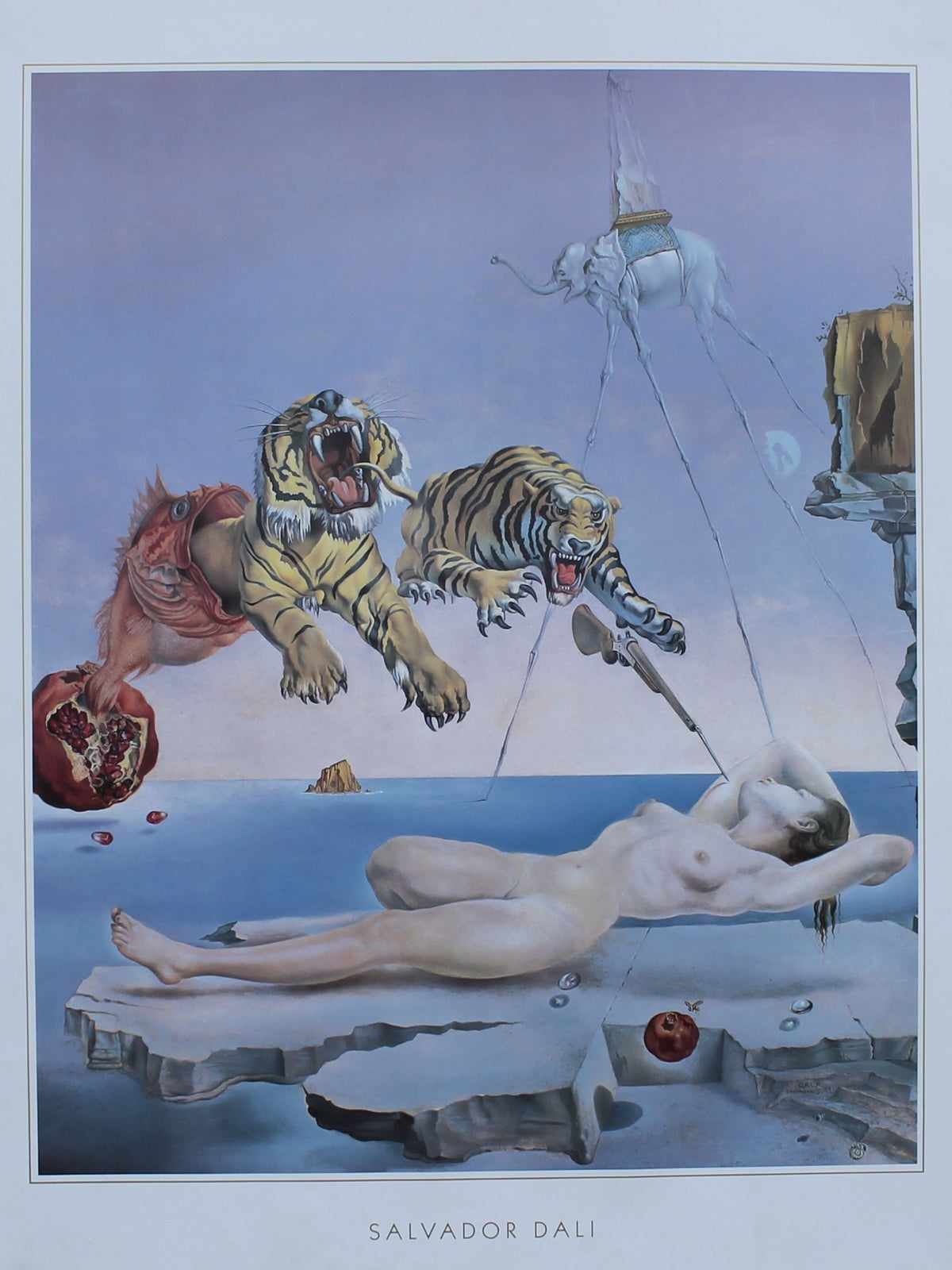
The artwork is Salvador Dalí’s famous 1944 Surrealist masterpiece, titled Dream Caused by the Flight of a Bee Around a Pomegranate a Second Before Awakening (Rêve causé par le vol d'une abeille autour d'une grenade, une seconde avant l'éveil), frequently shortened in French prints to Une seconde avant l'éveil.
Key Facts
- Artist: Salvador Dalí
- Date Completed: 1944 (painted in the United States while Dalí and Gala lived in exile during WWII)
- Medium & Original Size: Oil on wood panel, 51 cm × 40.5 cm (20 in × 16 in)
- Current Location: Museo Nacional Thyssen-Bornemisza, Madrid, Spain
Core Concept & Freudian Roots
Dalí described this piece as a "hand-painted dream photograph." Its central premise was inspired by Sigmund Freud’s The Interpretation of Dreams—specifically the concept of an instigation dream, where an external sensory stimulus occurring in the real world is instantly translated into a complex, narrative dreamscape right before waking.
Dalí noted that the buzzing and impending sting of a single bee in waking reality manifests in Gala’s subconscious as an escalating chain of violent, explosive imagery ending in the jab of a bayonet.
Key Imagery & Symbolism
- The Sleeping Nude (Gala): Dalí’s wife, muse, and manager, Gala, floats peacefully above a flat stone block resting over calm Mediterranean waters (reminiscent of Port Lligat, Dalí's home in Catalonia). Her body remains untouched by gravity, symbolizing the weightless suspension of sleep.
- The Pomegranate & Bee: Floating beside Gala are two drops of water, a tiny honeybee, and a small pomegranate casting a heart-shaped shadow. In classical and Christian iconography, the pomegranate represents fertility, resurrection, and Venus/sensuality, while the bee symbolizes both industry and the physical catalyst of the dream.
- The Erupting Chain Reaction:
- A colossal pomegranate splits open over the water, spewing a furious yelloweye rockfish (rascasse).
- Out of the fish's mouth bursts a roaring bengal tiger, which in turn gives birth to a second leaping tiger.
- Directly in front of the second tiger, a rifle bayonet points squarely at Gala’s arm, symbolizing the sharp, sudden sting of the bee that is about to jar her awake.
- The Spindly-Legged Elephant: In the background, an elephant with elongated, spindly "insect/flamingo" legs strides effortlessly across the sea, bearing a marble obelisk on its back. This was Dalí’s first painted use of the space elephant motif (inspired by Gian Lorenzo Bernini’s 1667 sculpture Elephant and Obelisk in Rome's Piazza della Minerva), a recurring icon of desire, immense weight carried by fragile support, and surreal distortion that he later featured prominently in The Temptation of St. Anthony (1946).
Cultural Impact
The piece remains one of Dalí's most recognizable and analyzed works, bridging classical Renaissance draftsmanship with 20th-century psychoanalysis and surrealism. Because of its visual impact and narrative composition, it became one of the most widely licensed and reproduced museum prints throughout Europe and North America during the latter half of the 20th century.