1
/
of
7
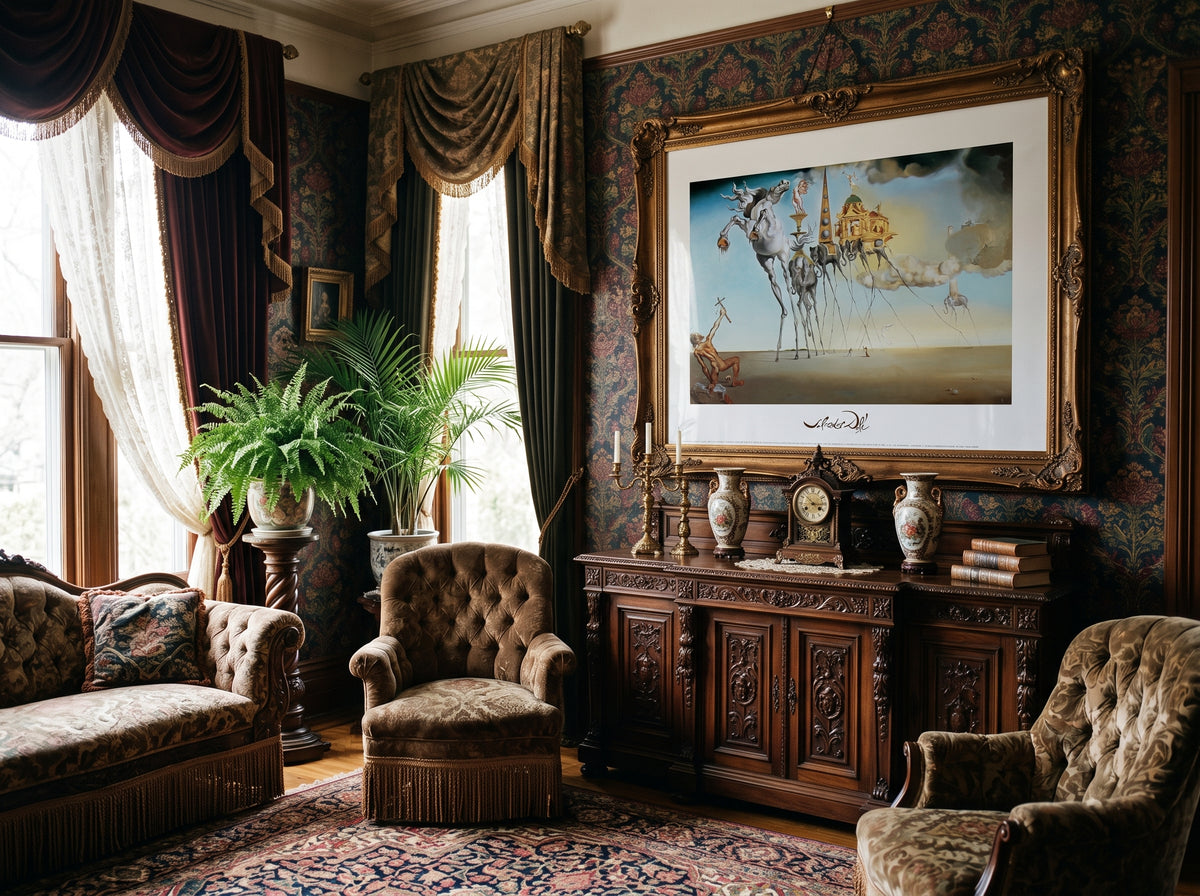
Salvador Dali - The Tempation of St Anthony 11.25 x 9.5
Salvador Dali - The Tempation of St Anthony 11.25 x 9.5
Regular price
$29.99 USD
Regular price
Sale price
$29.99 USD
Shipping calculated at checkout.
Quantity
Couldn't load pickup availability
The Temptation of St. Anthony (La Tentation de saint Antoine) is an oil on canvas painted by Salvador Dalí in 1946. The original canvas measures 89.5 cm × 119.5 cm and is held in the permanent collection of the Royal Museums of Fine Arts of Belgium (Musées Royaux des Beaux-Arts de Belgique) in Brussels.
Origin and History
- The Bel Ami Art Contest: Dalí painted this work in New York to submit to the Bel Ami International Art Competition. The competition was organized by the film producers David L. Loew and Albert Lewin to select a single painting to appear in full color within their otherwise black-and-white film adaptation of Guy de Maupassant’s novel, The Private Affairs of Bel Ami (1947).
- The Outcome: Twelve prominent artists submitted entries, including Dalí, Max Ernst, and Paul Delvaux. Ernst ultimately won the grand prize ($2,500) and the screen appearance with his version, while the other artists, including Dalí, received an honorarium of $500. Despite missing the film slot, Dalí’s entry became one of the most celebrated and reproduced Surrealist works in art history.
- Pivotal Period: Painted in 1946, the work marked Dalí’s transition into his "Nuclear Mysticism" and classical renaissance phase, where he merged Catholic religious iconography, classical perspective, and atomic/surrealist physical concepts like levitation and suspended mass.
Iconography & Symbolism
The painting depicts Saint Anthony the Great (c. 251–356 AD), the Christian desert father who retreated into the Egyptian desert and faced intense demonic trials and visions:
- Saint Anthony and the Cross: Anthony is shown naked, crouched on a barren plain, leaning against a rock with a human skull nearby—symbols of mortal decay and ascetic vulnerability. He thrusts a wooden crucifix upward to ward off the encroaching visions, pitting spiritual faith against worldly desire.
- The Rearing Steed (Raw Passion & Pride): At the head of the caravan, a wild stallion rears up with flared nostrils and cloven, inverted hooves, representing unrestrained carnal passion, brute force, and pride.
- The Elephants on Arachnid Legs (Distorted Power): Behind the horse comes a procession of elephants mounted on extraordinarily elongated, spindly "spider legs". Dalí used this motif to contrast immense physical and material weight with extreme structural fragility and weightlessness.
- The Burdens of Temptation:
- Lust: The first elephant carries a golden chalice surmounted by a voluptuous nude female torso, symbol of sensual indulgence.
- Worldly Power & Science: The second carries a monumental Bernini-inspired obelisk, echoing the monument in Rome’s Piazza della Minerva, evoking earthly authority and geometry.
- Hedonism & Opulence: The third carries an ornate golden temple or pavilion enclosing another fragmented female body.
- The Cloud Tower: In the haze further back, a solitary elephant carries a colossal monolithic phallic tower rising into the clouds, representing unattainable pride and spiritual distraction.
Print Production Details (Image Edition)
- Publisher: The lower margin identifies this specific print run as licensed and published in the Netherlands by Verkerke Reprodukties N.V. / Verkerke C&L GmbH (Ede, Holland), authorized by Demart Pro Arte B.V. and the Belgian Royal Museums.
- Format: Rendered in Verkerke's classic art gallery collector format, featuring Dalí's calligraphic signature printed centered beneath the image plate and catalog attribution text set along the bottom baseline.