1
/
of
5
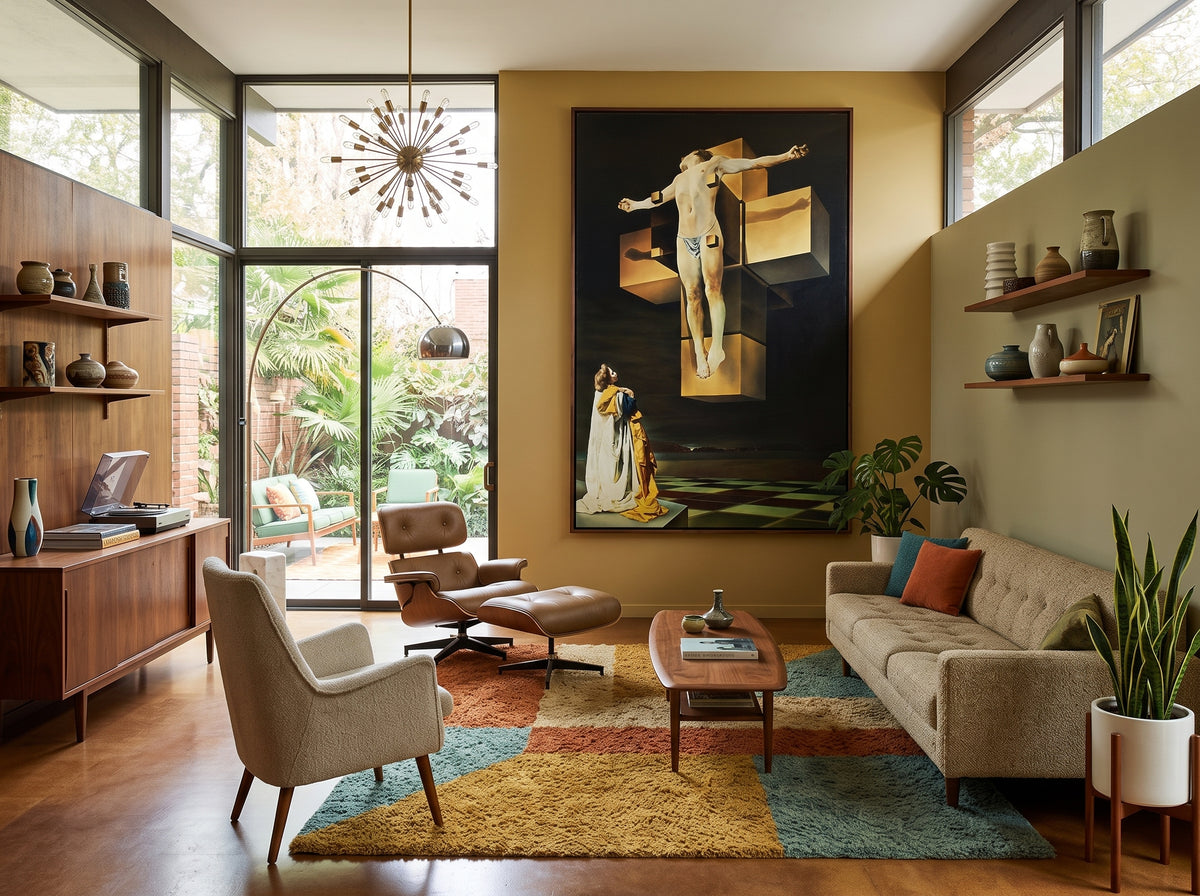
Salvador Dali - The Cruzifiction 23.75 x 31.5
Salvador Dali - The Cruzifiction 23.75 x 31.5
Regular price
$29.99 USD
Regular price
Sale price
$29.99 USD
Shipping calculated at checkout.
Quantity
Couldn't load pickup availability
Crucifixion (Corpus Hypercubus) is an oil-on-canvas painting completed by Salvador Dalí in 1954. It hangs in the permanent collection of the Metropolitan Museum of Art in New York City.
Key Details & Dimensions
- Original Title: Crucifixion (Corpus Hypercubus)
- Original Dimensions: 194.3 cm × 123.8 cm (76.5 in × 48.7 in)
- Print Version Shown: A licensed museum exhibition poster (standard vintage reproduction measuring roughly 23.75 × 31.5 in).
- Collection / Provenance: Donated to The Met in 1955 by the Chester Dale Collection.
Concept & Symbolism
- Nuclear Mysticism: Created during Dalí’s post-World War II period, the work belongs to his "Nuclear Mysticism" phase. Following the atomic bombings in 1945, Dalí shifted away from orthodox Surrealism to reconcile modern particle physics, classical Renaissance draftsmanship, and Roman Catholic theology.
- The Hypercube (Tesseract): Instead of a wooden Latin cross, the cross is a net of a tesseract (an unfolded four-dimensional hypercube composed of eight cubes). Just as unfolding a 3D cardboard cube yields a 2D cross shape, unfolding a 4D hypercube in 3D space produces a cross of eight cubes. Dalí used this mathematical construct to symbolize Christ existing in a transcendent, higher-dimensional reality inaccessible to ordinary physical perception.
- Absence of Blood and Nails: Christ does not touch the cross; he levitates slightly in front of it. There are no nails, blood, crown of thorns, or physical wounds, framing the Crucifixion not as an ordeal of bodily suffering, but as an act of cosmic, divine elevation.
- The Figure of Gala: The draped figure standing in the lower-left foreground is Dalí’s wife and lifelong muse, Gala Dalí, positioned as a witness or contemplative worshiper looking upward.
- Setting & Composition: Gala stands upon a checkerboard pavement set against a desolate, dark shoreline based on the bay of Port Lligat, Dalí’s home village in Catalonia,