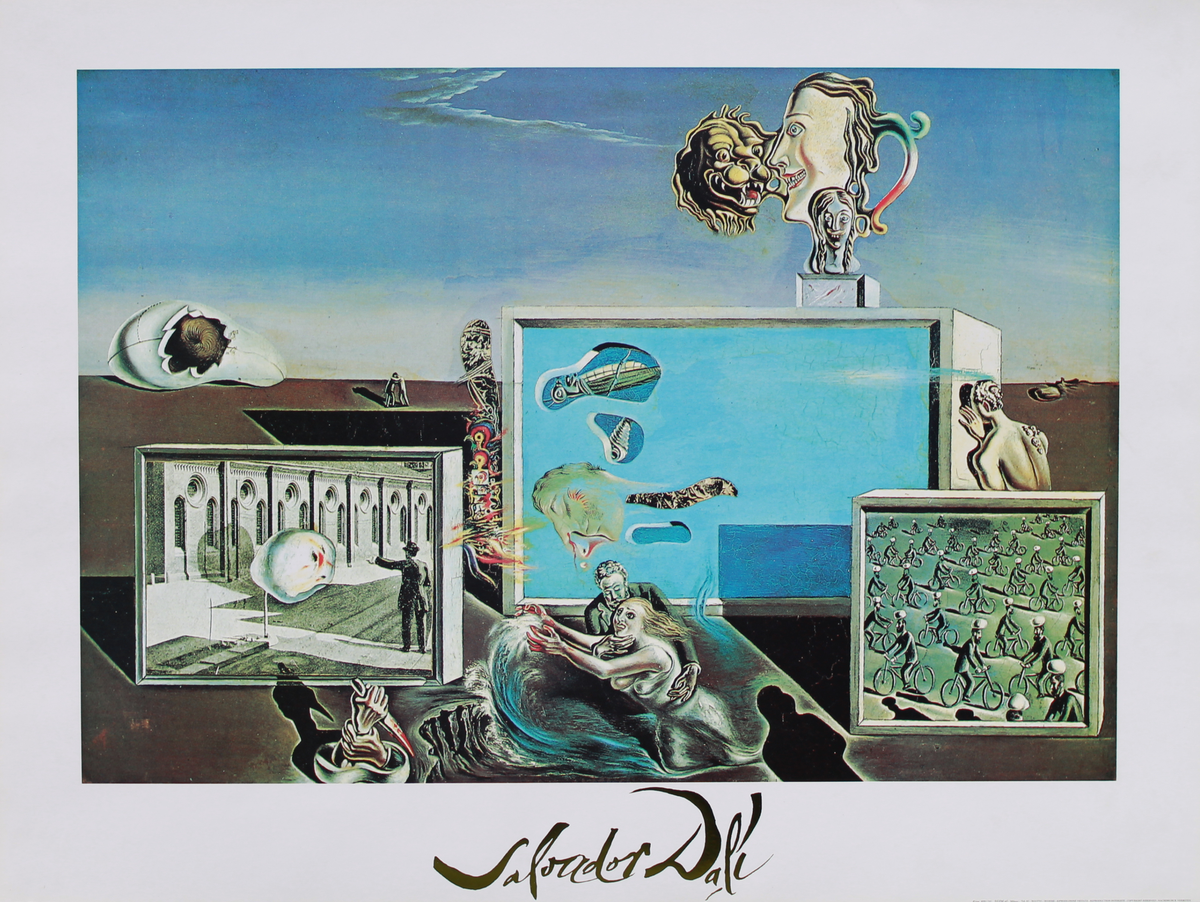
Salvador Dali - Piacori Illuminata 31.25 x 23.5
Salvador Dali - Piacori Illuminata 31.25 x 23.5
Couldn't load pickup availability
This painting is Salvador Dalí's seminal 1929 Surrealist masterwork, titled Illumined Pleasures (also cataloged in French as Les plaisirs illuminés and Catalan as Els plaers il·luminats).
The filename in the image—labeled "Piacori Illuminata"—is a typographical corruption/phonetic distortion of its Italian translation, Piaceri Illuminati.
Museum and Catalog Details
- Artist: Salvador Dalí (Spanish, 1904–1989)
- Title: Illumined Pleasures (Les plaisirs illuminés)
- Date Completed: 1929
- Medium: Oil and collage on composition board / chipboard panel
- Original Dimensions: 9 3/8 × 13 3/4 in. (23.8 × 34.7 cm)
- Current Location: The Museum of Modern Art (MoMA), New York City
- Accession / Credit: Object number 584.1967, Gift of The Sidney and Harriet Janis Collection (1967)
- Catalogue Raisonné: Fundació Gala-Salvador Dalí, Ref. P 241
Provenance & Exhibition History
- Original Provenance: Acquired originally from Dalí's milestone first solo Paris show at Galerie Pierre Goemans (November–December 1929). It was owned sequentially by key Surrealist writers Louis Aragon and Paul Éluard, before passing to the renowned dealer Julien Levy in New York, and subsequently into the prominent Sidney and Harriet Janis Collection, who donated it to MoMA in 1967.
- Key Historical Exhibitions: Included in the landmark MoMA exhibitions Fantastic Art, Dada, Surrealism (1936), Dalí's 1941 MoMA retrospective, and the major traveling international exhibition Dalí: Painting and Film (MoMA / Tate Modern / LACMA, 2007–2008).
Iconography and Significance
Painted in the summer/autumn of 1929 at Cadaqués—the exact period when Dalí met Gala and officially joined the Surrealist group led by André Breton—Illumined Pleasures is one of his most densely concentrated psychological works:
- Cinematic Screens / Diptych Boxes: The three framed interior boxes function as projected movie or television screens. Dalí, heavily influenced by his work with Luis Buñuel on Un Chien Andalou (1929), used these illuminated windows to project subconscious desires and paranoiac visions.
- Freudian Fears and Castration Anxiety: The foreground depicts a man restraining a woman whose hands are soaked in blood, flanked by grasping hands holding a bloody dagger—Dalí's signature shorthand for sexual terror, guilt, and castration complexes.
- The Paranoiac-Critical Face: Dalí's sleeping, soft self-portrait profile (the embryonic, waxen head that later anchors The Great Masturbator and The Persistence of Memory) floats inside the central box, perforated by cavities and streaming fluid.
- The Bicyclists: The right screen shows men in bowler hats riding bicycles balancing rocks on their heads, a motif directly linked to the bourgeois figures appearing in the scenario notes for Un Chien Andalou.
- The Lion and Jug-Heads: Perched atop the architectural block are Dalí's roaring lion (symbolizing untamed libido and animal passion) and a woman's head merging into an earthenware vessel, referencing the transformation of desire.
Print / Poster Authentication Note
The image shown is an authorized exhibition or museum-edition fine art poster produced in the late 20th century (the bottom border features Dalí's calligraphic signature and small-print museum copyright and catalog credits). The stated dimensions of 31.25 × 23.5 inches represent the full publisher sheet size of this lithographic poster, whereas Dalí's original oil painting at MoMA is a surprisingly intimate, jewel-like miniature measuring roughly 9.4 × 13.7 inches.